
Motorcycle Accessories for Beginners: What to Prioritise First
New riders should prioritise motorcycle accessories that solve a recurring, meaningful riding need and fit the specific motorcycle without adding avoidable distraction or complexity. Treat protective riding gear as a separate rider-protection category; then prioritise navigation, carrying, visibility or security, storage protection and roadside preparedness only when current riding conditions make those functions useful.
Beginner accessory priority decision aid
Tick only the situations that are already recurring in your riding. The result identifies the accessory function to evaluate first; it is not a universal shopping list.
Decision rule: prioritise a function when the need is frequent, the practical consequence matters, existing equipment does not already solve it, and fit and operation are suitable for your motorcycle and attention demands.
Protective riding gear remains separate from accessory selection. Before buying any accessory, verify motorcycle fit, mounting or electrical requirements where relevant, and whether the accessory adds more distraction or burden than benefit.
The decision starts with expected use: a rider with limited built-in storage may place greater value on a carrying solution, while a rider who regularly navigates unfamiliar routes may give greater weight to a suitable navigation setup. Weather exposure, parking conditions and access to assistance can shift the priority again.
This page focuses on beginner-specific decisions. For the wider category, see the motorcycle accessories guide.
Table of Contents
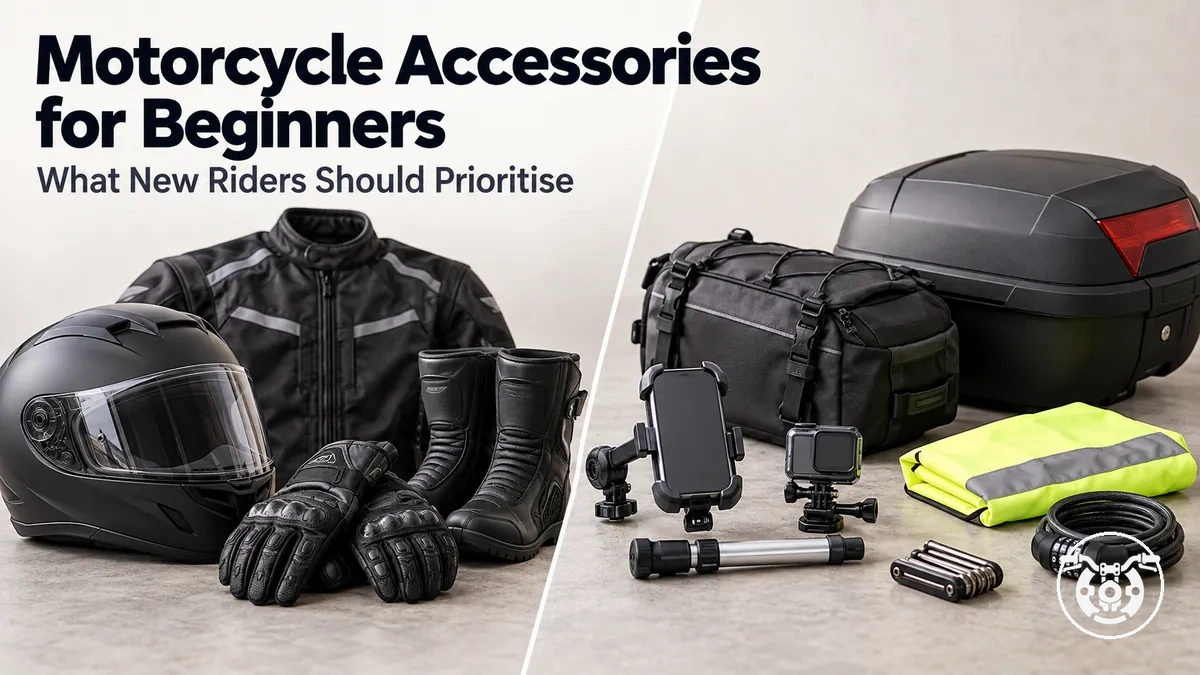
Motorcycle Accessories Are Not a Substitute for Essential Riding Gear
Motorcycle accessories do not replace protective riding gear because the two categories serve different functions. Protective riding gear is worn for rider protection, while accessories support functions such as visibility, navigation, storage, theft deterrence or motorcycle protection.
Keeping that boundary clear helps a new rider judge each accessory by the riding need it addresses rather than treating every item as the same kind of “gear”.

Keep the two categories separate
Protective riding gear
Primary value: rider protection.
Examples: helmet and protective jacket.
Motorcycle accessories
Primary value: adds or supports a motorcycle-related function.
Examples: navigation mount and luggage.
A reflective accessory can support conspicuity, but that does not make it protective riding gear. Likewise, luggage or a navigation mount addresses storage or navigation rather than rider protection.
For beginners, the recurring riding need should determine accessory priority after protective riding gear has been considered separately.
What Makes an Accessory a Priority for a New Rider
A high-priority accessory for a new rider solves a frequent, meaningful riding need without adding avoidable complexity, distraction or burden.
Priority rises when the expected practical benefit matches the rider's actual conditions and frequency of use, while motorcycle fit and ease of use remain suitable for a beginner. Safety support, carrying needs and budget relevance strengthen the case only when they address a defined need rather than an assumed one.
The following criteria provide a practical check before treating an accessory as a priority.

Priority criteria
- Recurrence and benefit
- Give more priority when the need occurs regularly and the missing function has a meaningful practical consequence.
- Motorcycle fit
- Verify that the mounting method, dimensions or configuration suit the specific motorcycle before treating the accessory as suitable.
- Attention and ease of use
- Favour operation a beginner can manage without unnecessary attention; reduce priority when distraction or complexity outweighs the benefit.
- Safety role
- Use an accessory only for the function it can support; do not treat it as a substitute for protective riding gear or safe riding practices.
- Burden and budget
- Accept added storage, weight, setup or cost only when the accessory solves a recurring need rather than a rarely used function.
These criteria connect the accessory to a riding condition and then to a priority outcome: an accessory used frequently for a defined need can justify greater priority when its fit and operation are suitable, while one with an occasional or unclear benefit can carry less priority.
For example, the same luggage accessory can be a higher priority for a rider with regular carrying needs and a lower priority when normal trips require no extra storage. The difference follows from frequency of use and practical need, not from the accessory category alone.
The broader how to choose motorcycle accessories method expands these criteria beyond the beginner context.
A new rider should therefore prioritise an accessory when its practical benefit is recurring, its fit is suitable and its use does not introduce disproportionate distraction, complexity or burden.
Beginner Motorcycle Accessory Priorities by Practical Need
Beginner motorcycle accessory priorities should follow practical need rather than popularity or accessory count. An accessory function deserves earlier attention when the need is frequent, lacking the function has a meaningful consequence, and existing equipment does not already address it.
Need frequency and the consequence of lacking the function provide the main organising logic for priority.
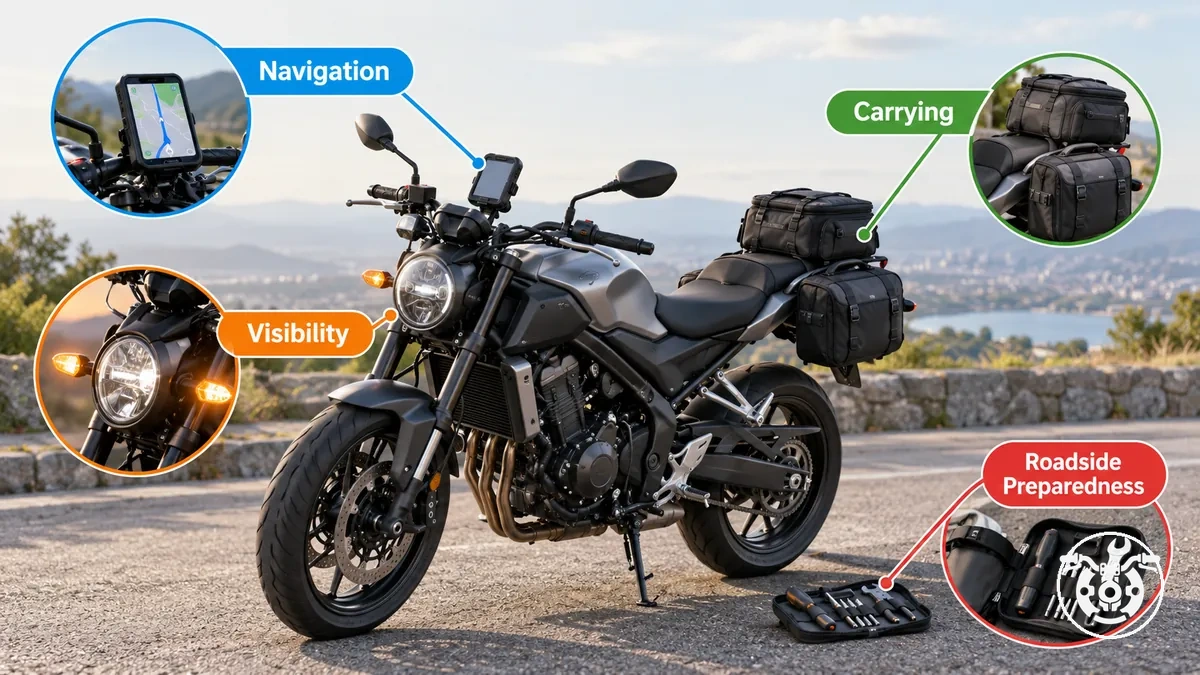
When each function moves up or down the priority list
Visibility and motorcycle protection
Earlier: when conspicuity, public parking, weather exposure or motorcycle-damage concerns are recurring.
Later: when the relevant concern is already addressed by the riding or storage environment.
Navigation, communication and power
Earlier: for frequent unfamiliar routes or a recurring communication or device-power need.
Later: for familiar local riding when the added cockpit setup would bring little benefit.
Luggage and storage protection
Earlier: when items are carried regularly or the motorcycle is commonly stored in exposed conditions.
Later: when there is no extra carrying need and storage is already sheltered.
Roadside preparedness
Earlier: when realistic minor checks may be useful before assistance is available.
Later: when suitable equipment or assistance already covers the likely need.
The detailed accessory groups that follow apply this same riding-condition-to-functional-need relationship without imposing a universal order.
Visibility and Motorcycle Protection
Visibility and motorcycle protection cover three distinct outcomes: visibility support improves conspicuity, theft deterrence adds a barrier against unauthorised access, and motorcycle-protection items are intended to limit certain types of bike damage.
Each becomes relevant under a different riding or parking condition rather than providing the same form of protection.
Visibility support
Example: reflective accessory.
Value: supports conspicuity when visibility is a concern; it does not imply collision prevention.
Theft deterrence
Example: lock.
Value: adds a physical barrier in exposed parking conditions; it cannot guarantee that theft will not occur.
Bike-damage mitigation
Example: frame slider.
Value: is intended to mitigate certain contact damage under applicable conditions, not protect the rider.
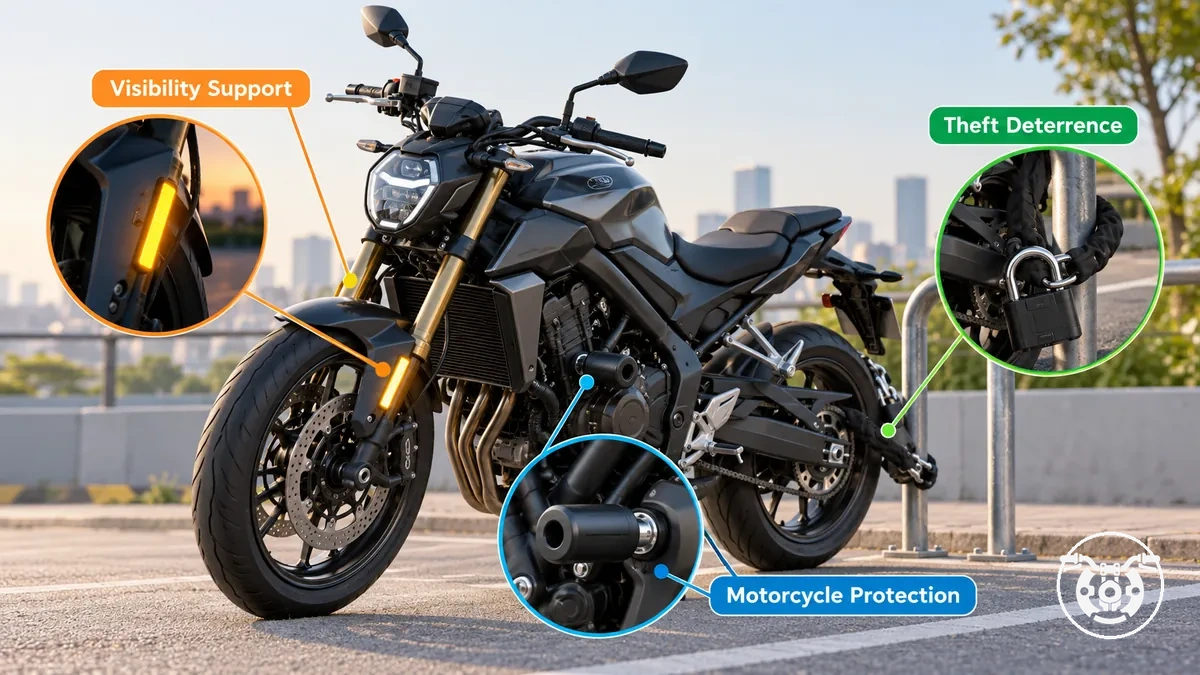
A motorcycle regularly parked in a publicly accessible location can make theft deterrence more relevant than controlled storage. Under a riding condition where conspicuity is the concern, visibility support is the relevant function instead.
These functions support visibility, theft deterrence or motorcycle protection; none substitutes for protective riding equipment used for rider protection.
Navigation, Communication and On-Bike Power
Navigation, communication and on-bike power should be prioritised only when they solve a recurring trip need without creating disproportionate distraction or complexity.
A phone mount or GPS mount is more suitable when secure mounting keeps the device stable and clear of normal motorcycle controls, while an intercom is more relevant when communication is genuinely part of regular trip use.
On-bike power, such as a USB charger, becomes more relevant when recurring accessory use creates a power demand that the specific motorcycle and accessory configuration can support.
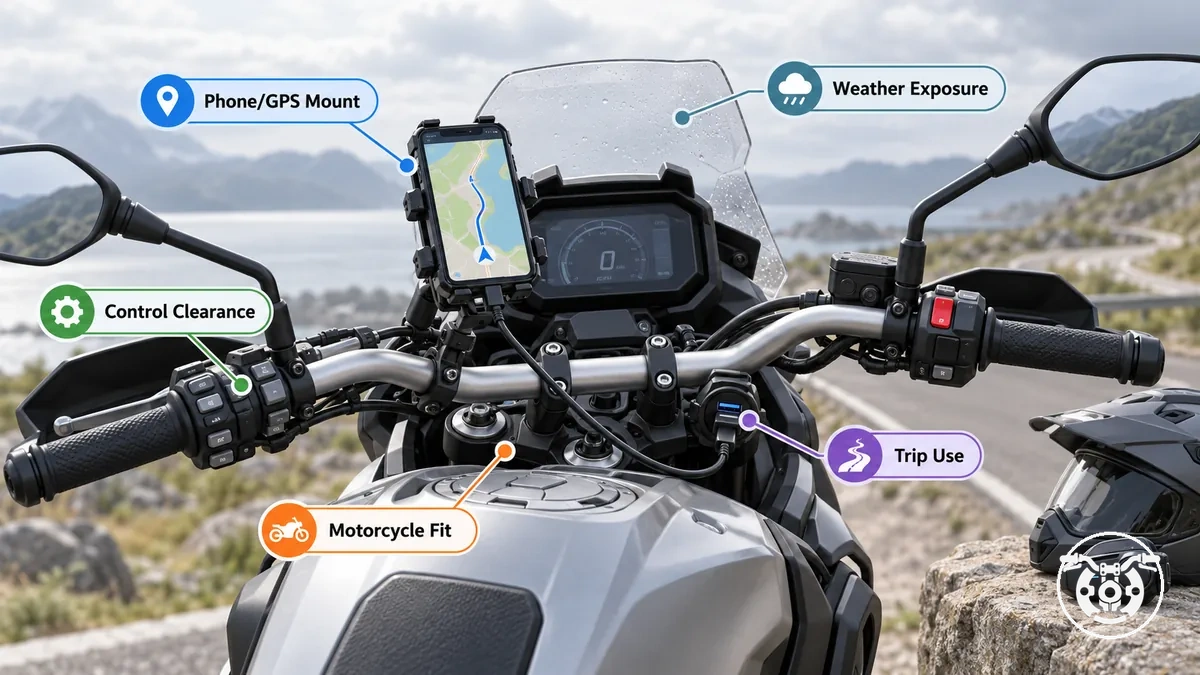
Check these conditions before prioritising the setup
- Mounting: the device remains secure and does not obstruct normal controls or the rider's required view.
- Recurring utility: navigation, communication or charging is used often enough to justify the added setup.
- Weather suitability: the device, mount and connection method suit the conditions in which they will actually be used.
- Power compatibility: any charging setup matches the motorcycle and accessory configuration rather than assuming universal electrical fit.
- Attention demand: operation should not require disproportionate interaction while riding.
Mounting options vary with handlebars, available mounting points and accessory configuration, so check motorcycle accessory fit for the specific motorcycle rather than assuming compatibility across models.
A navigation, communication or on-bike power accessory is therefore a suitable beginner priority when its recurring utility justifies its mounting, configuration and attention demands.
Luggage and Weather or Storage Protection
Luggage or weather and storage protection becomes a higher priority when a rider regularly carries items or parks or stores the motorcycle in exposed conditions.
A tail bag or saddlebags can address recurring carrying needs when their capacity suits the items normally carried and their attachment is suitable for the specific motorcycle. A bike cover becomes more relevant when storage conditions create recurring weather exposure, while its weather resistance should be judged from the particular cover design and intended conditions rather than assumed.
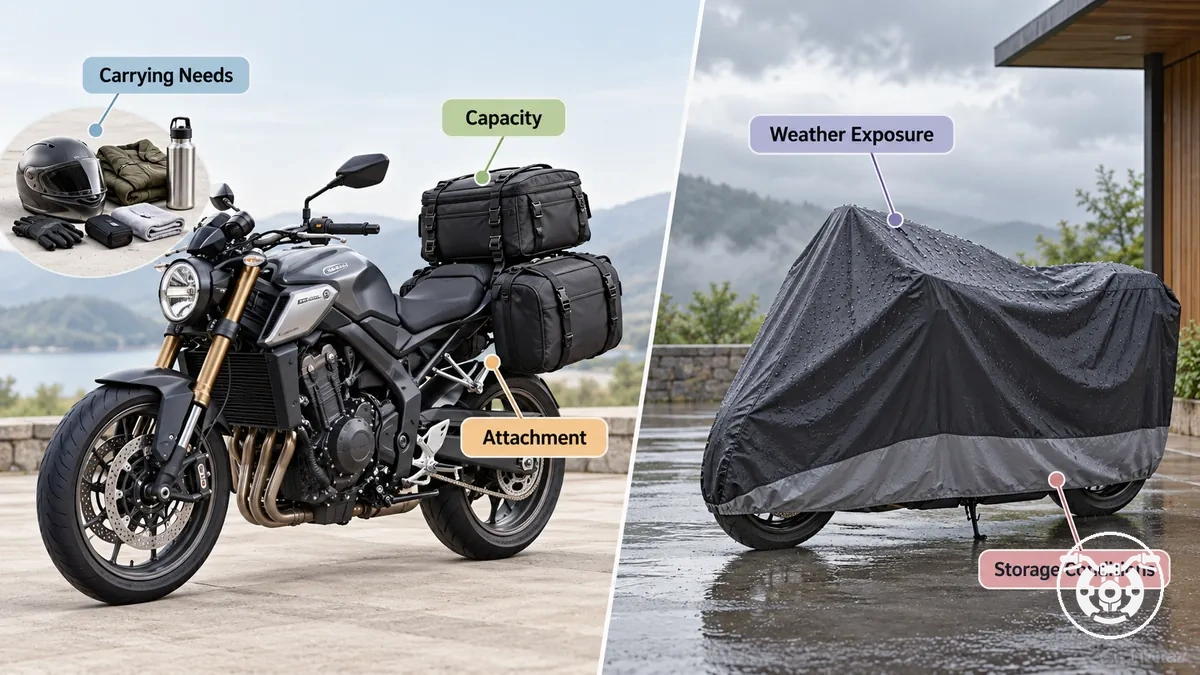
Regular carrying need
Good fit when: the required capacity matches the items normally carried and the attachment method is suitable for the motorcycle.
Lower priority when: normal trips do not require extra storage or existing storage already solves the need.
Exposed storage need
Good fit when: outdoor or exposed storage is recurring and the cover's intended weather resistance matches those conditions.
Lower priority when: storage is already sheltered and there is no recurring exposure problem to solve.
Capacity, attachment and storage exposure are decision values: the category name alone does not make luggage or a cover a beginner priority.
Roadside Tools and Basic Maintenance
A compact tool kit is worth carrying only when it supports realistic minor checks or recoverable roadside needs within the rider's competence. Portable tools such as a suitable socket or wrench can support a basic task when the rider understands the task and the tool matches the motorcycle component involved.
A patch kit can be relevant when the specific roadside condition falls within the kit's intended use and the rider knows how to use it, but other tyre faults may require assistance. Workshop-oriented equipment is less suitable for routine carrying when the likely task requires facilities, equipment or skills beyond basic roadside handling.
Roadside work boundary
- 1Handle only a task you can identify.
Use portable tools only when the fault is understood, the tool matches the task and the work is within your competence.
- 2Stop when the boundary is unclear.
Do not keep working when the fault cannot be confidently identified or falls outside the intended use of the available tools or repair kit.
- 3Shift to recovery or professional assistance.
More tools do not make a task suitable for roadside work when the required repair exceeds rider knowledge, tool capability or basic roadside conditions.
Seek recovery or professional assistance when the fault or required task exceeds rider competence or the intended capability of the available tools.
Accessories That Can Wait Until Your Riding Needs Are Clearer
Optional accessories with infrequent use, unclear personal benefit, duplicated functions or disproportionate added complexity can usually wait until riding experience reveals a clearer need. Deferral does not mean rejection; actual use can show whether the expected benefit justifies adding the accessory later.
Three qualified outcomes
Buy now
Use this outcome when the need is frequent and established, the benefit is clear, fit is suitable and current equipment does not already provide the function.
Reconsider later
Use this outcome when the need is plausible but unproven, riding style is still developing, or setup, weight, space or complexity may outweigh the current benefit.
Skip for now
Use this outcome when the function is irrelevant to current riding, duplicates equipment already in use, or has no clear practical benefit.
For example, a beginner riding short familiar routes may have little benefit from an optional add-on designed for a use case that has not developed. Later experience can change that decision if riding style creates a recurring need and makes the benefit clearer.
Expected benefit should be judged against current use rather than the accessory category alone. A deferred accessory can become useful later when conditions, habits or equipment change.